Infractions that cost you points on your licence in Spain

Points on your licence in Spain

Drivers in Spain start with 8 points on their driving licence when they pass their test. So do those who have lost their licence previously and receive it back after serving their penalty.

After three years and assuming the driver has not lost any points the total increases to twelve. If you don’t commit any infractions for a period of three years the traffic authority will add two points to your total. After another three years, you can gain an additional point up to a maximum of 15 points.

Points are lost when a driver in Spain is caught breaking the road traffic laws. It depends on the seriousness of the offence as to how many, if any points are lost.

Probably the most frequent cause of a loss of points on your Spanish driving licence is speeding. If the speed limit is 50 kph and you are doing between 51 and 70 kph you will incur a fine but you won’t lose any points on your driving licence. However, if you are caught doing 71kph  in a 50kph zone then you will be fined and lose two points. Over 80kph and the points lost rises to 4 and then 6 for 91kph plus. Below is a table showing both the fine and the points lost. You may want to read more about Speed limits in Spain here.

Fines and points lost for speeding in Spain

There are plenty of other reasons you can lose points on your Spanish driving licence. Some of them are listed below:

Description Points lost
1 Driving with excess alcohol in the bloodstream. 4-6
2 Driving under the influence of drugs. 6
3 Refusing to give an alcohol or drugs test. 6
4 Driving recklessly, in the opposite direction or participating in illegal races. 6
5 Driving with equipment installed that prohibits traffic surveillance and radar detection. 6
6 Exceeding by 50% the time permitted to drive or taking less than 50% of the time for a rest as defined in the legislation for road transport vehicles. 6
7 Altering the tachometer or the speed restriction of a vehicle. 6
8 Driving without the appropriate category of licence. 4
9 Throwing objects into the road that could cause a fire, an accident or block traffic circulation. 4
10 Not respecting Stop, give way signs or traffic lights on red. 4
11 Improper overtaking. 4
12 Overtaking and putting cyclists in danger. 4
13 Changing direction where prohibited. 4
14 Reversing on a motorway or dual carriageway. 4
15 Not respecting the instructions from a policeman directing traffic. 4
16 Not maintaining a safe distance behind the vehicle in front. 4
17 Driving whilst using the mobile telephone, programming your Sat Nav, using headphones or other devices that may reduce your attention. 3
18 Driving without your seatbelt, or without appropriate systems of retention for children. 3
19 Driving whilst your licence is suspended or prohibited to use this type of vehicle 4

Speed limits in Spain

speed limits in spain

THIS POST IS NOW OUT OF DATE. PLEASE GO TO OUR NEW POST ON SPEED LIMITS IN SPAIN.

Once driving in Spain, especially on the motorways, you will soon realise what a pleasure it can be, compared to the congested motorways of the UK, for example.

However, in order not to spoil your trip, you will need to keep alert of the various speed limits. The fines can be large and will ruin most people’s day and may come accompanied by the removal of some points from your licence. In Spain, you start with 12 points on your licence. This can go up to 15 if you continue to keep out of trouble. If you are penalised for a traffic infringement then points can be deducted from the total you currently have.

Speed Limits in SPain
Infographic: DGT.es

For the main reasons for incurring a loss of points on your licence you can visit this article.

In urban areas, the maximum speed limit is generally 50 kilometres per hour unless otherwise indicated. On secondary roads, the speed limit depends on the width of any hard shoulder. So the maximum speed will be 90 kilometres per hour or 100 kilometres per hour. If you are travelling on a motorway then the speed limit for cars and motorcycles is a maximum of 120 kilometres per hour. Clearly, if there is a road sign indicated a lower speed limit or roadworks indicating a reduced speed then that signal takes precedence over the highway code norm.

If you are towing a trailer in Spain on a motorway then the maximum speed limit is 90 kph, if the maximum weight of the trailer is 750kg or less. If the trailer is larger then the maximum speed is 80 kph. On conventional roads outside of an urban area the speed limit would be 80 kph if there is a hard shoulder of 1.5 metres or 70kph if not.

The level of fine and penalty points lost will depend on the speed over the limit you were doing at the time and how quickly you are prepared to pay the fine. Here is a table that explains what the fine (multa) will be and how many points will be taken from your licence (puntos). Usually, the fine is halved if you pay within a short period of time, which is detailed in the penalty notice you receive.

Speeding fines in Spain
Infographic: DGT.es

Buckle up for the ride

wearing seatbelts in spain

The DGT (Direccion General de Trafico) recently launched its latest campaign aimed at people not using their seatbelt and also checking child restraint systems.

It seems that there are still a serious minority not wearing their seatbelt and the figures for last year are not encouraging. In 2017, 229 users of cars and vans that did not use a seatbelt died, 39 more than the year previously. It is said that using your seatbelt will half the chances of dying in an accident.

In the case of children, they are five times more likely to suffer serious injury if they are travelling without the property safety restraints.

These safety devices are not only a legal requirement but have been scientifically proven to save lives. So why do people still take these risks?

The authorities objective is to educate people not using these devices of their effectiveness. Pere Navarro said, “the belt is still, today, the single most effective safety device in vehicles. The DGT aims, with this type of campaign, to raise awareness of the importance of its use, both in adults and children, in front or rear seats, on urban or interurban roads, on long or short journeys. The belt and the SRI, always. There is no option. ”

The number of deaths in 2017 from the non-use of seatbelts and appropriate child restraint systems rose from 190 to 229 which is a worrying trend.

If you need some statistics to convince you why you should be wearing a seatbelt then here they are:

– The use of seatbelts and SRIs is mandatory for all occupants of a vehicle, on any route (either short or long) and on any road (urban or interurban).

– It is a basic and fundamental element of road safety and its use has saved thousands of lives. According to various studies of the European Union, fastening the seat belt when traveling in a vehicle would save the lives of more than 7,000 people in the European Union each year.

– Protects both from getting thrown out of the passenger compartment, as well as from hitting the windscreen.

– Its use in the rear seats is essential. In a frontal impact, the probability of a rear seat occupant fatally striking another passenger in the front seats is multiplied by eight.

– The belt reaches maximum effectiveness in rollovers, where the risk of death is reduced by 77%.

– Beware of the airbag: its use is not effective if it is not complemented by the use of the safety belt: both are designed to work in a complementary way.

– The occupants move at the same speed as the vehicle. For example, in a braking the vehicle stops, but the travelers move: a collision at 50km / h is equivalent to falling from a second floor.

– A frontal collision at 80 km / h without wearing a safety belt, usually results in death or serious injury.

Don’t play with children

The safety of a child will depend on the driver, as well as the use of the appropriate safety restraint. It is your responsibility.

In addition, drive calmly, respecting the road traffic laws, without being aggressive, maintaining the correct safety distance between you and the vehicle in front and adjusting your speed the level of traffic. This is the best way to protect the little ones.

In all vehicles, up to nine seats, including the driver, minors of less than 135 centimetres (regardless of age) should use approved child restraint systems properly adjusted to their height and weight and they must be in the back seats.

If you are found not to be complying with this law the road traffic authorities can immobilise your vehicle.

AESVI (Spanish Alliance for Child Road Safety) among its ten fundamental rules, it lists the following aspects

  1. In a vehicle, always carry the child in a restraint system suitable to its size and weight, however short the journey. Never, under any circumstances, leave the child alone or without supervision.
  2. Always use approved chairs, and if possible, opt for the more current regulations, since the security requirements are greater.

Check the approval label, in which the size must be indicated and / or the weight for which the product has been approved.

Source: DGT.es

Two wheels, fun and comfortable in and out of town

The enthusiasm for motorcycles in Spain is not that surprising given the climate and the problems parking in some of the most populated areas.

In the south of Spain many cities are crammed full of motorbikes, scooters and mopeds. They are often squeezed into every available space. This mode of transport is more environmentally friendly than a petrol or diesel guzzling car, is cheaper to run and takes up less room in the city centre.

Three of the first four towns for most motorbikes per inhabitant are in the province of Málaga. Rincon de la Victoria tops the table with 71 per inhabitant whilst Mijas has 62 per inhabitant. Velez Malaga was fourth with 55 behind Ceuta.

Gerona has the most scooters with 100 per inhabitant in Blanes, 90 in Sant Feliu de Guixots and 83 in Lloret de Mar.

When it comes to mopeds then Cipiona and Rota in Cádiz are one and two with 76 and 66 mopeds per inhabitant respectively.

In the summer riding a motorcycle can be much more comfortable and fun. With such little annual rainfall you can also use them almost year round. If you have a larger machine, you can also get out of town and enjoy the fairly traffic free motorways and it is a great way to get out into the countryside.

Insurance prices for two-wheeled vehicles vary significantly from company to company and for different models too. For the larger sports bikes for example, it can be harder to find competitive prices but they are out there. For the lower powered scooters there are many more insurers but it pays to shop around.

By using an independent broker, they will search the market for you making it easier for you to find a suitable deal.

You will also have someone to help you in the event of a claim. Whilst an independent broker obvious cannot change an insurance company’s policy conditions to suit your claim, they can work with you to see that you are being treated fairly within those conditions.

If you would like a no obligation quotation, then please ask for a quotation form by completing the quote form with as much detail as possible.

Statistics from the DGT.es website.

Blue lights for emergency vehicles in Spain

Blue lights for emergency vehicles in Spain

This week will see the introduction of blue lights for emergency vehicles, such as ambulances and fire engines in Spain. It is the start of a programme that will run for two years.

Currently, many emergency vehicles have orange lights, the same as agricultural vehicles, dust carts and road sweepers.

The plan is that with all emergency vehicles carrying blue lights then there will be less confusion for motorists. With slow vehicles and roadside maintenance vehicles no longer using the same colour flashing lights as an ambulance or fire engine, motorists will be able to identify more easily an emergency vehicle.

The blue lights will only be used for emergency vehicles. Many other countries have adopted the use of blue lights for emergency vehicles and this new regulation will bring Spain more in line with its neighbours.

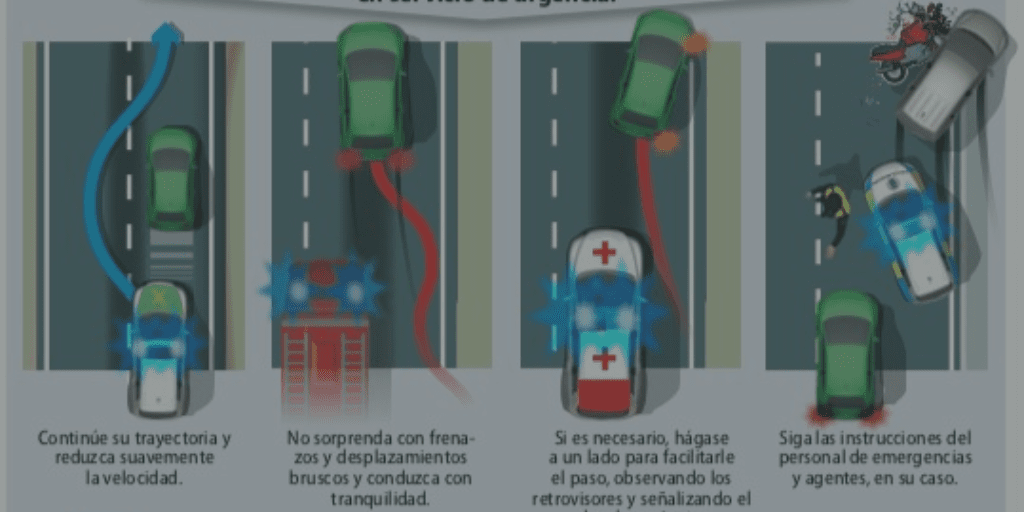
Image: DGT

What should you do when you see an emergency vehicle with its lights flashing?

  • Continue in your lane and slow down gently.
  • Don’t brake suddenly and make sudden changes of direction. Drive calmly.
  • If it is necessary, move to the side of the road to make it easier for the emergency vehicle to pass. Use your mirrors and signal clearly.
  • Respect and follow the instructions of emergency personnel or police officers if they are there giving instructions.

No Parking in Spain

no parking car insurance spain

Despite what you might see, especially in some smaller towns, there are rules for parking in Spain and a series of signs and road markings to help you avoid getting it wrong. Fines are high and the inconvenience of marching from one building to another to settle up with the police and then the compound will ruin your day.

You will often see people double parked, hazard lights on whilst they drop the children off at school, visit the cigarette shop or in some rare cases actually sit in a nearby restaurant and have dinner. As you would expect this is illegal, as is parking on a zebra crossing or too close to a junction.

There are a Parking car insurance spainnumber of road markings and signage that help you understand where you can park in Spain. Here we will attempt to point out some of those rules to help you avoid unnecessary traffic fines in Spain or perhaps worse having your car towed away to the municipal compound.

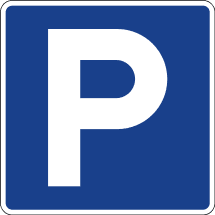
Let’s start with some basics. A large white letter “P” on a blue background or a variation is pretty common worldwide and means you can park your vehicle. You may be asked to park side by side with either the nose of the vehicle or the rear of the vehicle up against the kerb. This is known as “estacionamiento en bateria”.

The alternative is “estacionamiento en linea” where you park with the nose of your vehicle behind the rear of the car in front.

However what about the signs below? What do they mean?

A round sign with a red border, blue background and a red cross (fig.1) means that you cannot park. It also means you can’t stop and drop someone off or pick someone up.

The version with just one red line also means you cannot park but you can drop someone off or pick someone up (fig. 2).

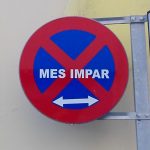
These signs can be accompanied by an array of words or numbers which alter the meaning. For example, if it has what looks like a capital letter “I” in the middle then means that you cannot park in this area on odd days (fig.3). If the sign has what looks like the capital letter “I” twice then you cannot park on even number days. So if it is the first of January you cannot park on a street with the sign shown in fig.3. However, you could park there on the second or the fourth or sixth.

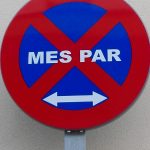
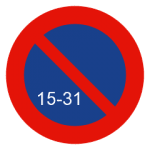
There are other variations on this theme. You might see “Mes Par” written on the sign in white writing (fig.4). This means that you cannot park in the zone when a month is an even number, that would be February, April, June etc.. Alternatively if it says “Mes Impar” (fig. 5) then that indicates no parking in January, March, May etc. Fig. 9  tells you that you cannot park in the zone from the 15th to the 31st of the month. Maybe there is one on the other side of the road marked “1-14”.

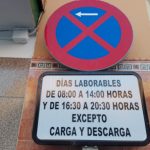
Other signage indicates that you cannot park in a zone on certain days, between certain hours. This sign (fig. 6) indicates that you cannot park to the left of it between 08:00 and 14:00 or between 16:30 and 20:30 on working days, unless you are loading or unloading. So, you can park in this area on Saturday or Sunday or public holidays. You can also park here at 21:00 at night or at 15:00 in the afternoon.

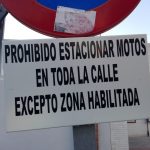
I cannot speak for all of Spain but the sign shown in fig. 7 has become prevalent in the area where I live. This sign is restricting where you can park your scooter or motorbike. It is usually put at the entrance to a street and states that scooters, mopeds and motorbikes can only be parked in designated zones. That means you cannot park them anywhere else in the street. If you choose to ignore it and park in the street outside of the designated zone you could be fined and/or towed away. The designated zones for these vehicles are usually painted with white lines or yellow lines. The word “moto” is also painted on the ground.

The “prohibido estacionar or vado” (fig. 8 click on the image to see full size) are often erected outside the entrances to car parks underneath blocks of flats, entrances to businesses or private garages. They are purchased from the local town hall. Basically, they give the owner of the sign the right to call the police and have your vehicle towed away if you are blocking their entrance.

In Spain a single solid yellow line near the kerb also means no parking.

There are other road markings that will help you stay the right side of the parking laws. Parking bays painted with white paint usually mean that the parking is unrestricted. If the bays are painted with blue paint then there is normally a limit to how long you can park and/or there may be a fee to pay in the nearby parking meter to. If you exceed your time in the blue parking zone you may be fined. The penalty can be settled immediately, using the same machine you bought your ticket at. This will result in a reduced fine and is far more convenient. The ticket machine will have an option to pay the fine.

Traffic fines in Spain

traffic finses in spain

Appealing against traffic fines in Spain.

You can also appeal against the fine you have received. However, if you pay a fine promptly you receive a 50% discount. If you decide to contest the fine and lose you will also lose the right to the 50% discount and will have to pay the full amount.

If you wish to provide evidence against the fine this must be done within 20 days after receiving the notification.

What do you do if you receive traffic fines in Spain but you weren’t the driver?

Assuming you don’t want to be held responsible for the offence and fine then you will need to provide the details of the driver of your vehicle to the authorities.

There is a list of necessary information you will need to provide to the authorities about the driver of your vehicle. You must provide this within 20 days of receiving the notification of the traffic offence.

You can send your response in writing either by fax or post. More details on this and the contact address and fax number can be found here.

How do I pay traffic fines in Spain.

You can pay the fine a traffic fine on the government website by credit or debit card. Alternatively, you can send a bank transfer. Details on how to pay a traffic fine in Spain can be found here. The credit card payment can be made here.

It is also possible to pay the fine in person at one of the Provincial Traffic department offices or in cash at Caixabank in Spain. If using the bank please make sure the correct and full reference details etc are included in the payment.

Spanish Police use drones to monitor traffic

traffic drones

The DGT have started to use drones to monitor the traffic. After a successful pilot scheme in May, the drones will be introduced in Tenerife and Gran Canaria in the first two weeks of August. They will also be used throughout Spain on days known as Operation Salida o Operation Retorno when there are huge numbers of journeys too or from holiday destinations.

These drones are equipped with long-range, high-resolution cameras and are ideal for use in well-known trouble spots to monitor traffic and driver behaviour.

In addition to the drones, there will be at least nine helicopters patrolling the roads and motorways of Spain throughout the summer. Three of these are based in Madrid. With an increase in traffic movements, this means more use of the helicopters in the skies above us.

Source: Dirección General de Tráfico

Can children sit in the front seat in Spain?

Can children sit in the front seat in Spain?

The answer depends on the child’s height and not their age. The DGT doesn’t recommend that children travel in the front passenger seat until they have reached 1.5 metres tall. However, the law stipulates they must be taller than 1.35 metres.

If the child is not taller than 1 metre 35 centimetres then they must sit in the back seats of a car in Spain.

There are three exceptions to this rule. One is if the car only has two seats.

Another would be where all the rear seats are already occupied by children 1.35 metres or less. In this case, they would be allowed to travel in the front passenger seat.

The final exception is when only two car seats can fit in the back. If you are carrying three small children and only two child seats can be securely installed in the back of the car then the extra child can sit in the front.

If a child is travelling in the front passenger seat, because of one of the exceptions mentioned above, then they must sit in a suitable rear facing child seat and the airbag must be deactivated. Depending on the make and model of car that might have to be done by a mechanic.

These rules have been designed to improve safety. If you breach these road traffic rules the authorities could fine you 200 euros and take three points off your driving licence.

How dangerous are Spanish roads ?

How dangerous are Spanish roads ?

What are the first thoughts that go through your head when you think about driving in Spain?

For some, there is a perception that it is a dangerous place to drive a vehicle.

How dangerous are Spanish roads ?
Photo: Pexels

I have lived in Spain for many years and I admit I still get frustrated by double parking, especially when there is a space available a few metres ahead. Also if you find that the person is sat in a café having dinner and has blocked you in your parking space. This also infuriates a lot of Spanish people but I’ve become more relaxed about these things. Someone stopping on a zebra crossing and chatting to their neighbours with the back half of the car protruding into the main road would have made me throw my hands up in despair about the potential danger to people trying to cross and the inconvenience I now have in trying to negotiate the rump of someone else’s car to continue my journey. Now it just provokes a sharp lift of the head and a slightly frustrated tutt. Then there is stopping to let someone out of the car without any indication and no intention to move to the side of the road to make it easier for other traffic to pass. This also receives a similarly much more composed response from me these days. But don’t be mistaken into thinking that only the natives drivers do this in Spain.

Whilst we all see things that seem to be dangerous and unnecessarily so, the statistics for Spanish roads are not all that bad. Perhaps it is because the things I’ve described happen in busy towns where traffic is unable to travel very fast and you come to expect the unexpected. But what about out of town?

Only this week a client was explaining to me how a flat-bed lorry sped round a country lane too fast and deposited its cargo on top of his car. Its cargo was a large cement mixing machine. It hadn’t been secured in the back of the lorry and the client was lucky to escape injury or even much worse. His car was not going anywhere after that accident though.

So what do we know about Spanish roads? All countries have black spots and most people can recall lanes or streets from years ago, from their own countries, notorious for close shaves or a series of terrible traffic accidents. Perhaps people had been calling for a road sign to warn drivers but nothing was ever done until a week after some poor soul had been killed.

What do the figures say about Spanish roads?

The latest figures I could find were from the Ministerio del Interior department Dirección General de Trafico and related to the year-end 2016. After the initial introduction by Gregorio Serrano López the Director General for Traffic the document states, with no time wasted “… a total of 1,810 people were killed at the time of the accident or within 30 days after its occurrence…” This is how road deaths are measured throughout Europe. If someone dies within thirty days of the road accident they become a road death statistic as their death would probably be as a result of the initial incident. It is a uniform measure used throughout Europe.

2016 was not a good year. The number of road deaths increased by 7% and the number of people that were hospitalized grew by 3%. The summer months of July and August are the most dangerous on Spanish roads, which is pretty logical bearing in mind the huge number of people going or coming back from holiday, national and international tourists alike.

Whilst 2016 saw an increase in road deaths in Spain the trend from 1989, the worse year since records began has been very positive. In 1989 there were 9,344 fatalities on Spanish roads but by 2013 the figures had plummeted to 1,680. In 2016 it was 1,810 people.

The number of vehicles on Spanish roads had surged by more than one million in the last decade. Possibly as a result of having suffered years of recession and austerity the average age of a car on Spanish roads has now reached 11 years whilst motorcycles are nine years. Back in 2007 when the financial crisis first bit in Spain the averages were 6.5 years for both cars and motorcycles.

So how does Spain compare?

Are Spanish roads dangerous ?
Photo Pexels

In 2010 the Spanish mortality rate from traffic accidents was 53 deaths per million inhabitants whilst by 2016 the figure was down to 39 per million. The European average in 2016 was 51.

In fact, Spain has the fifth lowest fatality rate in Europe. It’s mortality rate is as good as that of Germany and better than France, Italy and Belgium. It only lags behind Sweden, the UK, The Netherlands and Denmark in terms of road safety.

The safest roads are Spain’s motorways. Clearly, with everyone going in the same direction on a wide piece of tarmac this is not really that much of a surprise. Nor is the fact that traditional two-way roads between towns are the most dangerous. It is also not a shock that speed, alcohol and drugs are predominant factors in road fatalities.

To summarise

Spain’s roads are nowhere near the worst and despite double parking, stopping in the outside lane on roundabouts to nip in the shop and buy cigarettes, and blocking zebra crossings outside schools to drop off your children, it seems these actions are irritating, dangerous even, but likely to only involve an inconvenience in most cases, a possible injury in other cases, a fatality rarely but probably a loud tutt from me.

That doesn’t mean I recommend you start doing those things but perhaps continued vigilance and a laid-back response, if any, is all that’s needed, but pay particular attention on inter-urban roads, please.