Thousands Fined! The Truth About Driving Licenses Every Foreigner in Spain Must Know

Truth About Driving Licenses Every Foreigner in Spain Must Know

Important Driving License Rules for Foreign Residents in Spain: What You Need to Know

If you’re a foreign resident living in Spain, understanding the rules about your driving license is crucial. Many newcomers are unaware that failing to exchange or renew their foreign license can lead to serious consequences—and thousands are fined every year as a result.

In 2024 alone, more than 21,000 people were fined for driving with a license that wasn’t valid in Spain. Of these, over 16,000 had not exchanged their licenses, and more than 3,000 hadn’t renewed theirs after becoming residents. So, what are the rules, and how can you avoid becoming part of this statistic?

For EU/EEA License Holders

According to Spain’s General Regulation on Drivers (Article 15, Section 4), if you hold a driving license from an EU or EEA country, and you’ve been living in Spain for more than two years, you must renew your license in Spain, if it’s valid indefinitely or for more than 15 years (for standard categories like AM, A1, A2, A, B, and BE). For professional licenses (like C, D categories), the limit is five years.

Failing to comply with this rule is considered a serious administrative offense and can result in a €200 fine.

For Non-EU/EEA (Third Country) License Holders

If you’re from a non-EU/EEA country, your foreign license is only valid for six months after you obtain residency in Spain. After that, you must exchange it for a Spanish one—if your country has an exchange agreement with Spain.

Driving after this six-month window without a valid Spanish license can lead to a €200 fine if your license is exchangeable, and up to €500 if it is not (e.g., your country has no agreement or your license doesn’t meet the requirements).

Stay Legal on the Roads

Driving with an invalid license not only risks hefty fines—it could also void your insurance in the event of an accident. To stay safe and legal, check your license status and exchange or renew it as soon as required.

Need help exchanging your license? Contact Spain’s Dirección General de Tráfico (DGT) or consult your local town hall (ayuntamiento).

MiDGT mobile application

MiDGT mobile application

Contents

Introduction to MiDGT

MiDGT mobile application is the official name of the android/apple application from the Dirección General de Tráfico (DGT) in Spain.

Launched in March 2020 it gives the user access to their driving licence, the number of points they retain on their driving licence as well as details about Spanish vehicles registered in their name. More recently the DGT have added more features including being able to consult the taxes to pay when buying a car and ordering a report on a vehicle to see if there are any reasons why it cannot be transferred to a new owner, if you were thinking of buying it.

You can update your mobile phone and email address held by the DGT and authorise the receipt of notifications from the DGT.

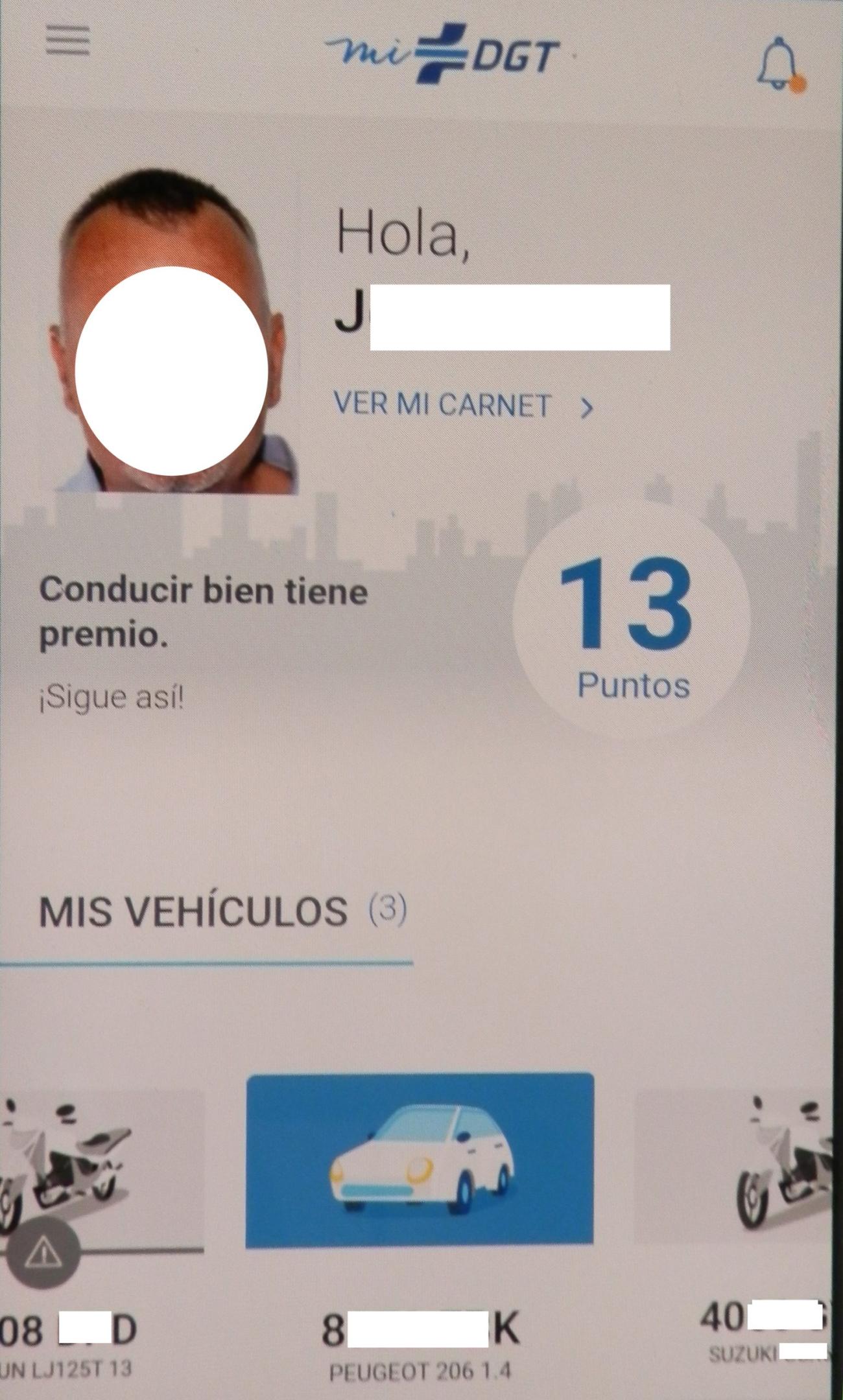
When you log in you will see your photo, your points summary and the vehicles you own listed further down.

In the top left corner are the three lines which opens up a menu. From here you can add your mobile phone number and email to the records that the DGT hold and also switch on or off a button to receive notifications.

Next to the welcome message and photo of the registered user is the option “Ver mi carnet”. Click here and this takes you to a copy of your Spanish driving licence.
MiDGT

Copy of your Spanish Driving Licence
MiDGT3
MiDGT mobile application 4

Once you click “Ver mi carnet” on the DGT mobile application your driving licence appears.

It will show all the details of the original plastic card that you probably have in your wallet.

Your date of birth, DNI/NIE etcetera. You can click to turn the card on the MiDGT mobile application around.

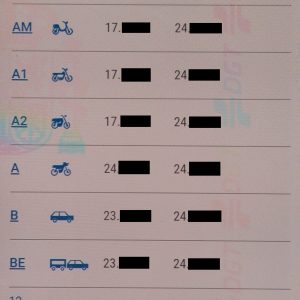
This then shows you the list of vehicle categories you have permission to drive. The dates of when you were authorised to drive each category of vehicle and the expiry date for each category is also shown in the same format as it is on the original pink plastic card licence.

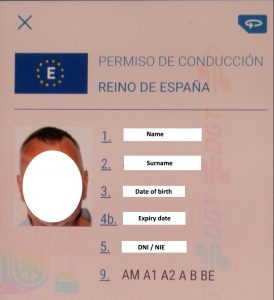
The image explains the front of the driving licence as it appears on the MiDGT mobile application. The letters and numbers next to row headed “9” are the categories of vehicles you have permission to drive.

In the top right corner you will see a blue arrow forming almost a circle. Click this icon and you are presented with the reverse side of your driving licence.

Here you have more details about the category of vehicles you have permission to drive. When you were authorised to drive them and when the category expires.

If you return to the first page we looked at, the one when you access the application then lower down you will see the list of vehicles registered in your name.

List of your Spanish vehicles

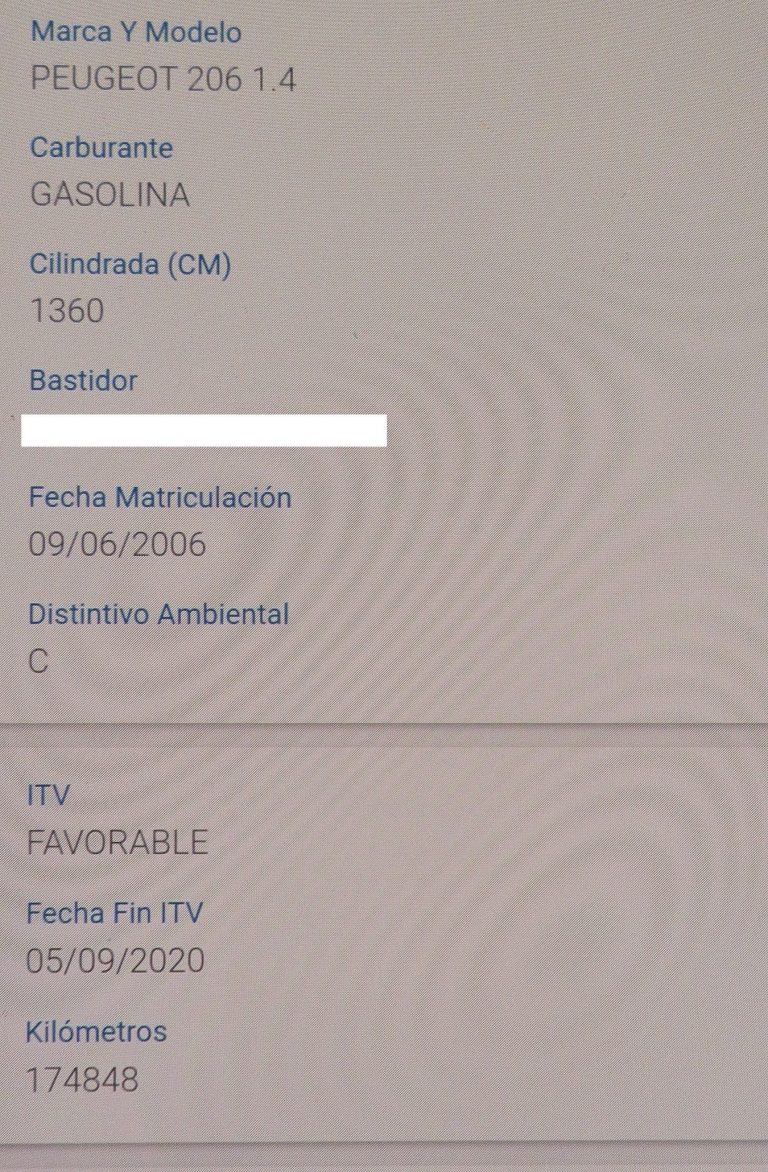
Here you can click on each one to find out more information about each one. There is information on the make and model of the vehicle, what fuel it uses and the engine size (cilindrada).

You will also find the VIN / Bastidor number and the date the vehicle was first registered. Now of course, it also has the environmental rating shown.

Further down the individual vehicle page you have confirmation of whether it passed the last ITV and very usefully the date the current ITV expires.

Lower down the page are the insurance records of the vehicle and the insurance renewal date.

For each vehicle registered in your name there is a record. You can access them one by one from the front page of the MiDGT mobile application.

DGT are expanding information available

The DGT has expanded the funcionality of the application since its launch. You can now carry out various administrative tasks from your mobile phone. You can pay relevant fees using the MiDGT mobile application, pay traffic fines, identify the driver who caused the traffic infraction if it was not you that was driving.
MiDGT mobile application

Get a vehicle report for a car in Spain

It is now possible to get both the short and full report on vehicles registered in Spain. This is particularly important if you are looking to buy a second hand car in Spain.

The full report is 8.67 euros (2022) and will show you if the vehicle is in a position to be transferred to a new owner.

  1. To obtain a vehicle report on a Spanish car then click the menu icon in the top left corner.
  2. Then select “informe de vehiculos”
  3. You will se a screen with two options. “Solicitar informe basico” which is a basic and free report. The second option and recomended option if you are thinking of buying a vehicle is “solicitar informe completo”.
  4. A new screen opens and you have to type in the registration number of the vehicle (matricula)
  5. Next you are asked to complete the reason for your request for the report (Motivo de la solicitud). There are currently four options. If you are looking at possibly purchasing the vehicle then click “posible adquisición del vehículo”
  6. Then click “seleccionar at the bottom of the page.
  7. Then you will be asked to pay the report fee (Pago de tasa) You can choose to pay by credit card or bank account. They only accept payment by debit or credit card from a limited range of banks so you may have to input your Spanish bank account details.
  8. Click to pay the tax and you can download the report to your phone.
vehicle information report spain
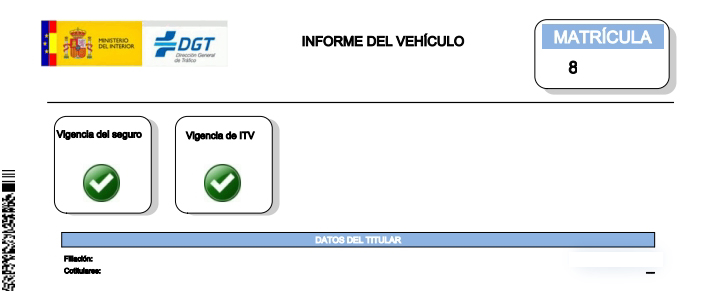
Top part of the first page of a vehicle report in Spain

Vehicle Report in Spain content

Once you have downloaded the report  you will see the registration number of the relevant vehicle in the top right hand corner. Just below and on the left you can see if the vehicle has an insurance policy in place and whether there is a current ITV (Similar to MOT in the UK). If there is then both will be indicated by a green circle with a white tick in it.

The next section will give the name of the current owner.

The third section headed “Identificación del vehículo” gives you information about the vehicle. It includes the registration number, the date it was first registered, the model, the VIN number, whether the car is leased (renting)  and the registered address of the vehicle.

The next section confirms the vehicle has insurance or not and with which company it is insured.

After that you will find a list of previous owners and whether they were individuals or businesses. There are further details on when each previous owner registered the car and finished being the owner.

“Historical de Inspecciones Técnicas” is the area where you will find details of the previous ITVs undertaken by the vehicle. You will see if it passed or not and if it failed was it a serious failure. It also shows the kilometres at the time of the test and the dates of the ITV tests.

After the ITV section you can find more technical information about the car. The engine size, the power of the engine, the number of seats, weight  and level of emissions.

Other sections may appear in the report especially if there is some adverse information. The report may indicate that there is an embargo on the vehicle or a loan outstanding on it. There also could be an indication that the vehicle is registered as “baja” or off the road with the traffic authorities and if so it should not be circulating.

There also could be an “incidencia denegatoria” which means you need to contact Trafico. It could be that there is some kind of restriction to rectify before it can be sold, for example.

How to download the application

The application can be downloaded using your android phone’s play store or if you are an apple user from the App Store.

To access the application you will either have to have a digital signature installed on your mobile phone or have access to the Cl@ve PIN application as part of the security measures to access the information.

To log in the first time I used the Cla@ve PIN application I already have installed on my phone. It makes it a bit cumbersome the first time but then the next time I wanted to log in I just had to use my finger print and went smoothly straight into the application.

The MiDGT mobile application has more and more functionality and the road traffic authority the DGT is keen to bring more features to the application in the future.

One final point, for the time being we still recommend you have possession of your physical driving licence on you whilst driving.

How to change a UK driving licence to a Spanish driving licence

How to change a UK driving licence to a Spanish driving licence

Updated 04/01/2026

Here’s a thorough, up-to-date guide on how to exchange (canjear) a UK driving licence for a Spanish driving licence now that Spain and the UK have a bilateral agreement in place:

1. Legal Context After Brexit

Since 16 March 2023, the UK and Spain have a reciprocal agreement allowing holders of UK driving licences to exchange them for Spanish licences without taking the Spanish theory or practical test, but under specific conditions. (UK weblink)

Important points:

  • Your UK licence is valid for driving in Spain for up to six months from the date you become resident. After that, you must exchange it to continue driving legally.

  • You can still exchange your UK licence after six months, but you cannot legally drive using the UK licence while the exchange is pending. 

2. What You Must Do Before Booking an Appointment

a) Obtain the DVLA “Check Code”

Spain’s DGT requires a DVLA check code to verify your licence details online during the exchange process:

  • For Great Britain (England, Scotland, Wales): use the UK Gov “View and share your driving licence” service to generate a check code valid for about 21 days.

  • For Northern Ireland, use the DVA equivalent service.

You will provide this code when you go for your exchange appointment.

b) Standard Documents Required

When you submit the exchange in person (or online where possible), typically the following are required:

  1. Original UK driving licence (photocard and counterpart if applicable). 

  2. DVLA check code (see above). 

  3. Passport or national ID (if applicable). 

  4. Proof of legal residence in Spain (TIE card or residencia details).

  5. Psychophysical (medical) certificate from a recognised centre — this tests vision and basic fitness to drive. 

  6. Passport-style photograph (32 × 26 mm in colour). 

  7. Proof of payment of the DGT fee (~€28-29). 

You will surrender your UK licence original at the DGT office as part of the exchange.

How to change a UK driving licence to a Spanish driving licence

How to Apply

There are three main ways to start the process:

1) In Person at a DGT Traffic Office (“Jefatura/Oficina de Tráfico”)

  • You book a “cita previa” (appointment) with the DGT.

  • At the appointment, you present all documents above and pay the fee.

  • You receive a temporary Spanish licence (provisional) to drive while the new one is processed. 

Tip: It’s often easier to book an appointment under the category “Trámites de Oficina – Conductores” if UK isn’t explicitly listed. 

2) Online Through the DGT Electronic Office (Sede Electrónica)

  • You can start the exchange online using Cl@ve or a digital certificate and upload documents.

  • After online submission and upload, you will be asked to attend only to hand in the original UK licence and collect the provisional Spanish one. 

3) Via a Gestoría / Representative

  • Many expats use a gestoría (administrative agent) to handle paperwork, especially if appointments are hard to get.

  • The gestoría may handle DVLA check codes, medical certificate coordination, and submission. 

After Submission

  • The DGT takes your UK licence and issues a temporary Spanish driving permit (to drive while the process completes).

  • Your official Spanish licence is mailed to your registered address, usually within 4–8 weeks (processing times vary by province).

Key Warnings / Common Issues

Residency timing: If you obtained your UK licence after becoming a legal resident in Spain, it may not be exchangeable under the agreement and you may need to apply for a full Spanish licence. DGT Sede Electrónica

Driving validity: After the six-month valid driving period on your UK licence, you must either complete the Spanish exchange or you are not legally allowed to drive in Spain until it’s done. 

Medical test: You must obtain a psychophysical (medical) certificate before or at the time of your appointment.

Summary Process Checklist

  • Get a DVLA check code.

  • Book a DGT appointment or prepare an online application

  • Get a medical (psicotécnico) certificate.

  • Gather documents (UK licence, ID, residence proof, photo). 

  • Attend DGT or submit online

  • Receive provisional licence and later Spanish card by post

Driving licences extended 60 days if they expire during the State of Alarm

How to change a UK driving licence to a Spanish driving licence

The Interior Ministry has issued an order extending the validity of driving licenses that expire during the state of alarm for 60 days. 

The order, published this Saturday in the Official State Gazette (BOE), states that “driving permits and licenses, as well as other administrative authorizations to drive, whose period of validity expires during the state of alarm, will be automatically extended while it lasts the same and up to sixty calendar days after its completion ”. 

The resolution, signed by the Minister of the Interior, Fernando Grande-Marlaska, also affects valid foreign driving licenses to drive in Spain. The law establishes that these permits are valid for six months from arrival in Spain and that, after that period, foreign drivers must exchange their country’s permit for a Spanish one. 

The order published today in the BOE establishes that the computation of those six months is paralysed during the state of alarm, and will resume once that period has ended. Therefore, foreign driving licenses for which the legal six months have not expired remain valid during the state of alarm. 

Essential vehicles exempt from some traffic restrictions

The resolution also affects certain vehicles that provide essential services such as the distribution of medicines, medical supplies or food. The Royal Decree, by which the state of alarm was established, indicates that the Minister of the Interior “may agree to close the circulation of roads or sections of them for reasons of public health, safety or fluidity of traffic or the restriction on access of certain vehicles for the same reasons. ” The order issued this Saturday indicates that these restrictions that may be established will not affect: 

a) Roadside assistance vehicles. 

b) Vehicles and road maintenance and maintenance services. 

c) Vehicles for the distribution of medicines and medical supplies. 

d) Urban solid waste collection vehicles. 

e) Vehicles destined for food distribution. 

f) The transportation of flux materials. 

g) Vehicles destined to transport fuels. 

h) Live livestock transport vehicles. 

i) The transport of perishable goods (fruits, fresh vegetables and others), provided that the perishable goods account for at least half of the vehicle’s payload capacity or occupy half of the vehicle’s payload volume. 

j) The vehicles of the State Society of Posts and Telegraphs. 

The restrictions will also not affect other vehicles “that help guarantee the supply of goods or the provision of essential services for the population.” The Royal Decree on the state of alarm already indicated that these restrictions did not affect emergency vehicles or police vehicles. The order signed by the Interior Minister has been issued, like the rest of the resolutions established under the Royal Decree on the state of alarm, in order to protect the health and safety of citizens, contain the progression of the disease and reinforce the public health system. The objective is to guarantee the supply of basic necessities and the provision of essential services for our society. 

To make this measure effective and guarantee unity and coordination in its execution, the order establishes that the General Director of Traffic, Pere Navarro, report the same “to those responsible for traffic in the Autonomous Communities, or, where appropriate, of the local entities that have assumed competences in the matter of traffic ”. 

DGT advise to change your UK driving licence to a Spanish licence before 31 January 2020

How to change your UK driving licence to a Spanish driving licence

The United Kingdom will cease to be a member of the European Union if BREXIT takes place. At that moment, all agreements related to driving licences will no longer be valid for UK nationals.

The DGT (Dirreción General de Trafico) advises that you get your driving licence changed over before the 31 January 2020. Although your UK driving licence will remain valid for a further period of nine months in Spain, the conditions to transfer to a Spanish one after BREXIT are unknown.

If you are living in Spain and want to transfer from a UK licence to a Spanish licence, it might be better to do it now. There is a standard protocol in place to exchange a UK licence for a Spanish licence now. After BREXIT, the UK and European countries would have to sign a new agreement to exchange driving licences.

The process is fairly straightforward and there are many people that will help you with the paperwork. Shop around though to make sure you are not over charged. The process takes around a month. You have to hand in your old UK licence and the DGT give you a temporary document, which you can show to the Spanish police if you are stopped, until your new Spanish licence arrives.

The DGT post your new licence to your postal address in Spain, meaning there is no need to return to the Regional Traffic Office to collect it.

If your UK driving licence has not expired, as mentioned above, you can continue to use it for up to nine months after BREXIT but the conditions to exchange it for a Spanish licence could change.

If you want to know more about changing your driving licence then you can read our article UK or Spanish driving licence.

Or for more detailed information on how to change your driving licence form UK to Spanish then we have produced a step-by-step guide to changing your driving licence.

Need help? You can contact us and depending on your location we might have a professional contact in your area that can help with the process.

How to change your EU driving licence to a Spanish driving licence

How to Exchange (Canje) an EU Licence for a Spanish Licence

Do you have to change an EU licence to a Spanish one?

Updated 04/01/2026

No — not automatically.


If you hold a valid driving licence issued by an EU or EEA country (Iceland, Liechtenstein, Norway), that licence is legally valid in Spain for driving as long as:

  • It has not expired, and

  • It has not been suspended/withdrawn. 

You do not have to immediately exchange it upon arrival or after a specific number of months just because you become a resident. It remains valid throughout its normal expiry period. 

When the exchange becomes effectively required:

  • If your EU licence expires, you must renew it — and this renewal is done in Spain (effectively a canje/exchange). 

  • If your EU licence has no expiry date or valid for an unusually long period (for categories like B/AM etc.), Spanish rules often require renewal after 2 years of residence — and that renewal is by exchanging into a Spanish licence. 

So:

  • Driving: you may continue to drive Spain on your EU licence while it is valid. 

  • Exchange is voluntary unless the conditions above apply.

How to Exchange (Canje) an EU Licence for a Spanish Licence

How to Exchange (Canje) an EU Licence for a Spanish Licence

If you decide to exchange your EU/EAA licence for a Spanish one, here are the practical steps:

Eligibility

  • You must be ordinarily resident in Spain. 

  • Your licence must be valid and not suspended/withdrawn. 

Requirements

Bring the following when attending your appointment at a main Police Station or DGT (Dirección General de Tráfico) office: 

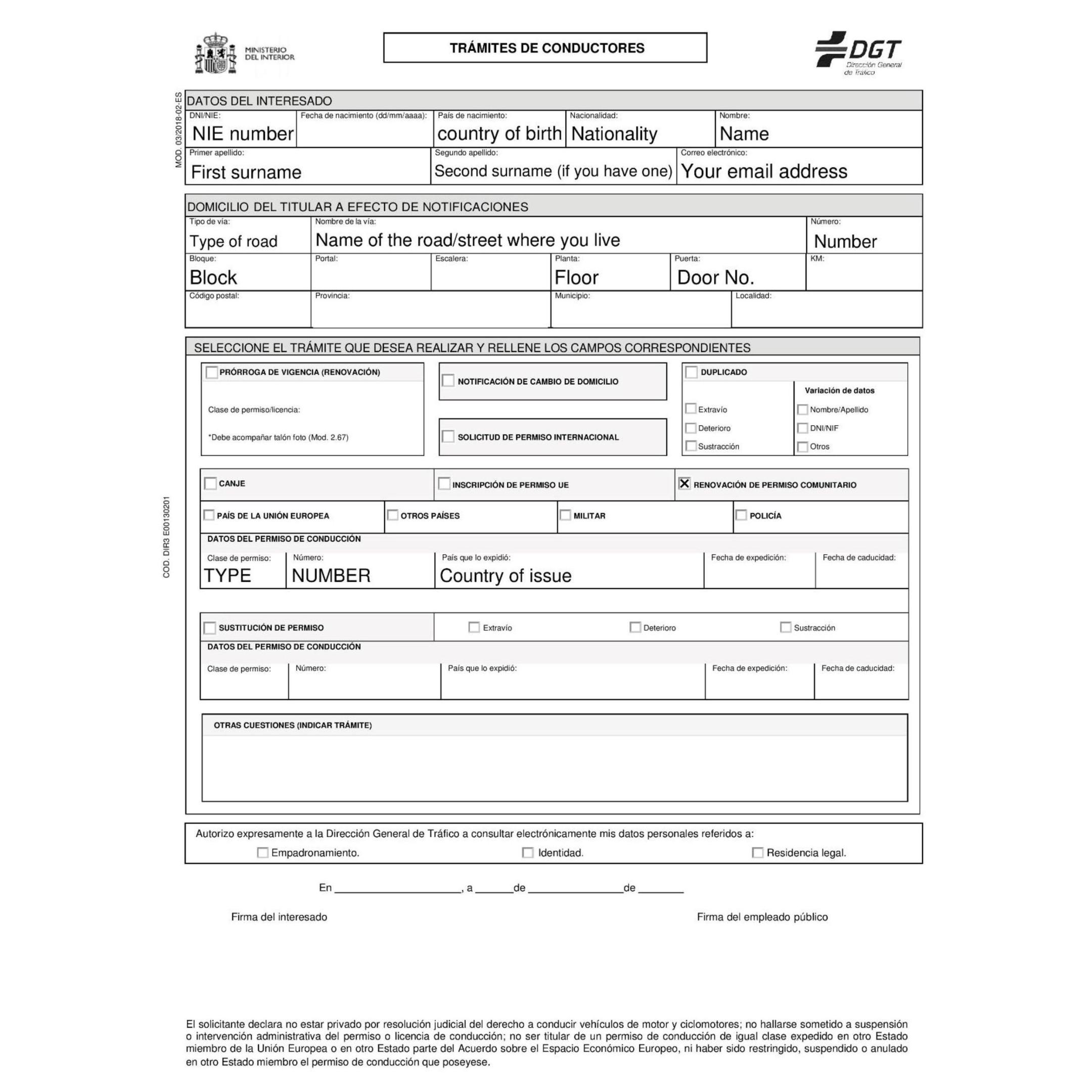
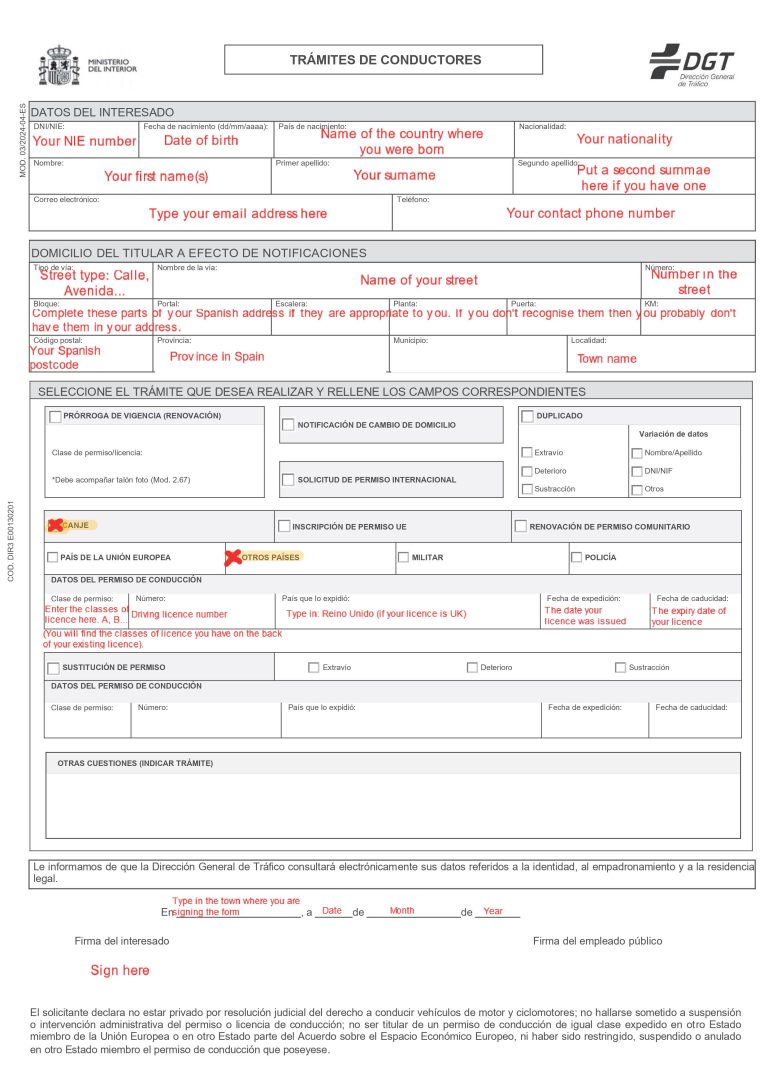
  1. Official application form for licence exchange (canje) — includes declarations about driving eligibility. 

  2. Identity document — passport or EU ID card, and proof of residence (e.g., certificate of entry in the foreigner’s register for EU citizens). 

  3. Your current EU driving licence (original). 

  4. Photograph (current passport-style photo). 

  5. Fee payment proof (for example, fee code 2.3, approximately €28-29). 

Process

  • Book an appointment (“cita previa”) for Exchanging driving licences with the DGT. 

  • On the day, submit your documents and licence. 

  • Your original EU licence is taken and you receive a provisional Spanish licence. 

  • The definitive Spanish licence is mailed to your address in about 4–6 weeks.

Important Notes / Common Misunderstandings

  • You are allowed to keep driving on an EU licence while it is valid; there is no automatic 6-month deadline for EU licences. (subject to the above).

  • Some outdated or local interpretations suggest a 6-month deadline; this applies mainly to non-EU licences without an agreement and not EU licences. 

  • Booking appointments can be challenging and usually requires a digital certificate or Cl@ve to book online; representation by a proxy is possible if you authorize them digitally.

Summary

EU Driving Licence in Spain:

  • Valid without exchange: Yes (as long as licence is valid and in date. See “when the exchange becomes effectively required above). 

  • Mandatory exchange? Only if the licence would otherwise expire or certain long-validity licences after 2 years residence need renewal. 

  • Procedure: Exchange at DGT with required documents; licence surrendered and replaced with Spanish one.

UK driving licences in Spain after 29 March 2019

UK driving licences in Spain after 29 March 2019

Although the Brexit deadline date is fast approaching the UK government only recently added information to its website regarding UK citizens using their UK driving licence in Spain.

According to the British Government website, if the UK leaves the European Union without a deal on the 29 March 2019 then you will not be able to exchange your UK driving licence for a Spanish one after that date

You will have to take a new driving test in Spain to obtain a Spanish licence.

If you wish to exchange your driving licence for a Spanish one then you can read our article on switching to a Spanish driving licence for guidance.

The Government website continues that, ” you might need an IDP to drive in all EU or EEA countries…” They provide a link to the AA website where you can find more information on International driving Permits.

According to the AA website mutual recognition of UK and EU driving licences may end. However, there is still nothing definitive.